Top 10 Best Private Banks in India List 2025
January 09, 2025

September 09, 2026
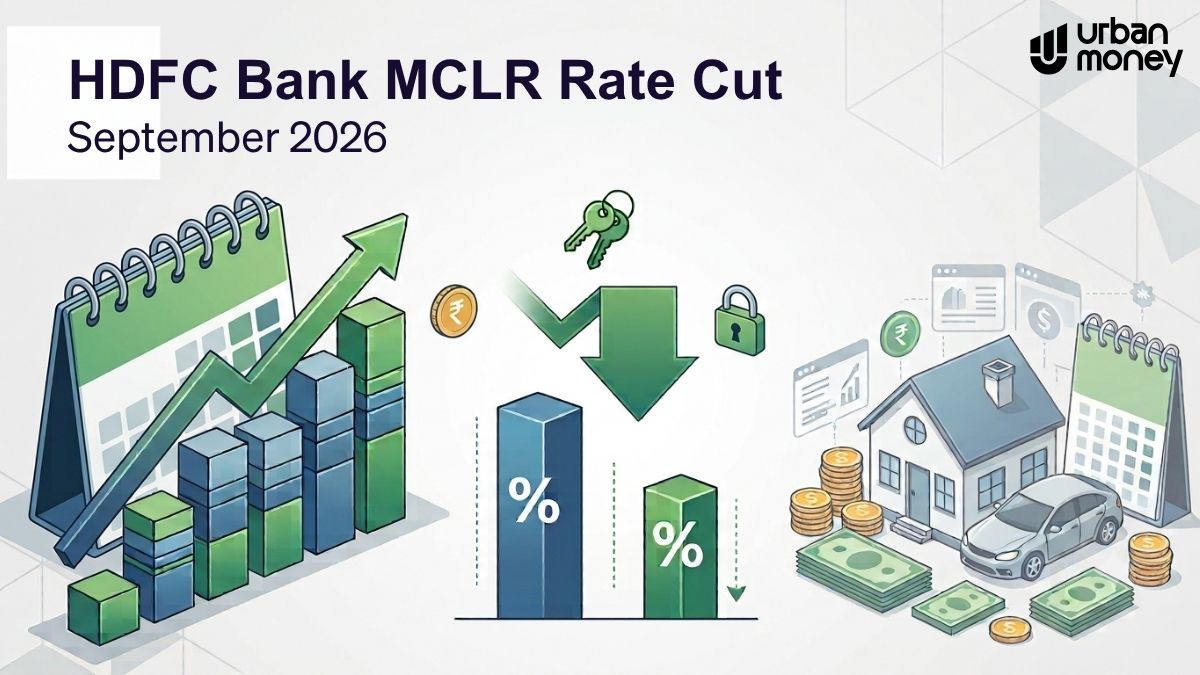
HDFC Bank has reduced its Marginal Cost of Funds-Based Lending Rate (MCLR) across all major tenures, offering some relief to borrowers whose loans are linked to this benchmark. The revised rates came into effect on September 7, 2026, with reductions ranging between 5 and 10 basis points.
The HDFC Bank MCLR rates reduction brings the range down to 7.90%-8.60%, compared with 8.00%-8.65% earlier. Overnight, one-month, three-month and two-year MCLR rates have fallen by 10 basis points, while six-month, one-year and three-year rates have been reduced by 5 basis points.
For borrowers, the immediate benefit may appear small. However, customers with large outstanding loan amounts and long repayment periods could save a meaningful amount of interest over time, particularly if further rate cuts follow.
The latest HDFC bank MCLR rates september 2026 are as follows:
| MCLR Tenure | Previous Rate | Rate From Sept 7, 2026 | Reduction |
| Overnight | 8.00% | 7.90% | 10 bps |
| One month | 8.00% | 7.90% | 10 bps |
| Three months | 8.15% | 8.05% | 10 bps |
| Six months | 8.30% | 8.25% | 5 bps |
| One year | 8.40% | 8.35% | 5 bps |
| Two years | 8.55% | 8.45% | 10 bps |
| Three years | 8.65% | 8.60% | 5 bps |
*Therefore, the HDFC bank MCLR rate latest revision places the overnight rate at 7.90%, while the widely tracked one-year MCLR now stands at 8.35%.
**MCLR is the minimum benchmark rate below which a bank normally cannot lend, except in cases permitted by RBI rules. A borrower’s actual loan rate is usually calculated by adding a spread to the relevant MCLR.
HDFC bank cutting MCLR rates reducing EMI for borrowers is broadly positive, but the benefit does not apply to every HDFC Bank borrower. Customers with older floating-rate loans linked directly to MCLR may benefit when their loan reaches its next reset date. The interest rate does not necessarily change immediately on September 7.
For example, consider a Rs 50 lakh loan with 20 years remaining. If the applicable interest rate falls from 8.40% to 8.35%, the monthly EMI would fall from roughly Rs 43,075 to Rs 42,918, assuming the tenure stays unchanged. That is a saving of around Rs 158 per month. If the lower rate remained in place throughout the remaining loan period, the illustrative saving could be about Rs 37,800. Similarly, on a Rs 10 lakh five-year loan, a reduction from 8.30% to 8.25% would lower the EMI by roughly Rs 24 per month. A Rs 5 lakh three-year loan moving from 8.15% to 8.05% would see an EMI reduction of around Rs 23.
The savings from one small rate cut are therefore limited, but repeated reductions can make a larger difference.
Since October 2019, RBI rules require new floating-rate retail loans, including home and auto loans, to be linked to an external benchmark. HDFC Bank’s present home loan rates are linked to the RBI policy repo rate rather than MCLR. The RBI repo rate currently stands at 5.25%.
This means the latest MCLR cut mainly affects older loans that continue to use MCLR and other business, SME or credit facilities contractually linked to it. Fixed-rate personal loans will not become cheaper merely because MCLR has fallen. Borrowers should check their loan agreement, sanction letter or latest account statement to identify the benchmark used for their loan.
The HDFC bank MCLR rate 2026 has not moved in one direction throughout the year. The bank reduced some shorter-tenure rates in May while increasing its three-year benchmark. In June, it raised selected MCLR rates by as much as 10 basis points. July saw further mixed changes. Most tenures were cut by around 5 basis points in August, followed by reductions across every published tenure in September.
RBI data showed net liquidity absorption of about Rs 10.49 lakh crore on September 8, indicating that the banking system was carrying a substantial liquidity surplus. The RBI had already reduced the repo rate by a cumulative 125 basis points between February 2025 and June 2026. During this period, lending and deposit rates across the banking system also moved lower.
This HDFC bank MCLR history shows that MCLR changes are influenced not only by RBI policy decisions but also by the bank’s own deposit costs, liquidity position, funding requirements and loan demand.
The latest HDFC bank MCLR rate change is particularly notable because the RBI did not reduce the repo rate at its August meeting. The central bank kept the repo rate unchanged at 5.25% with a neutral policy stance.
High liquidity can reduce the marginal cost of raising funds. Banks may then offer more competitive lending rates to attract quality borrowers.
HDFC Bank’s one-year MCLR of 8.35% is currently below several major peers reviewed in September.
However, this does not automatically mean an HDFC loan will always be cheaper. The final customer rate depends on the benchmark, spread, borrower profile, credit score and product type.
Existing borrowers should first confirm whether their loan is linked to MCLR, the repo rate, another external benchmark or a fixed rate. MCLR-linked customers should also check their reset date. A one-year MCLR-linked loan, for example, may not be repriced until its scheduled annual reset.
The September cut is not a dramatic EMI reduction on its own. Still, it is a positive development for eligible borrowers and may signal stronger competition among banks as liquidity remains high. For consumers, the key takeaway from the latest HDFC bank MCLR rates reduction is simple: check your benchmark before expecting a lower EMI. If your loan is MCLR-linked, the benefit should appear when the next reset takes place. If it is repo-linked, future EMI changes will depend more directly on RBI policy movements.


October 07, 2026

September 09, 2026
August 05, 2026
June 05, 2026
April 08, 2026
February 06, 2026





Top 10 Best Private Banks in India List 2025
January 09, 2025

Top10 List of Petrol Pump Companies in India
January 09, 2025

Dairy Farm Loan in 2025 : Online Procedure
January 09, 2025

Top 10 Best Bank for Home Loan In India…
January 09, 2025

Top10 Best Student Credit Cards in India 2025
January 09, 2025

Products & Offers

Tools & Calculators
CIBIL Score
Credit Cards
© 2026 www.urbanmoney.com. All rights reserved.


Need Loan Assistance?